Ranchi:
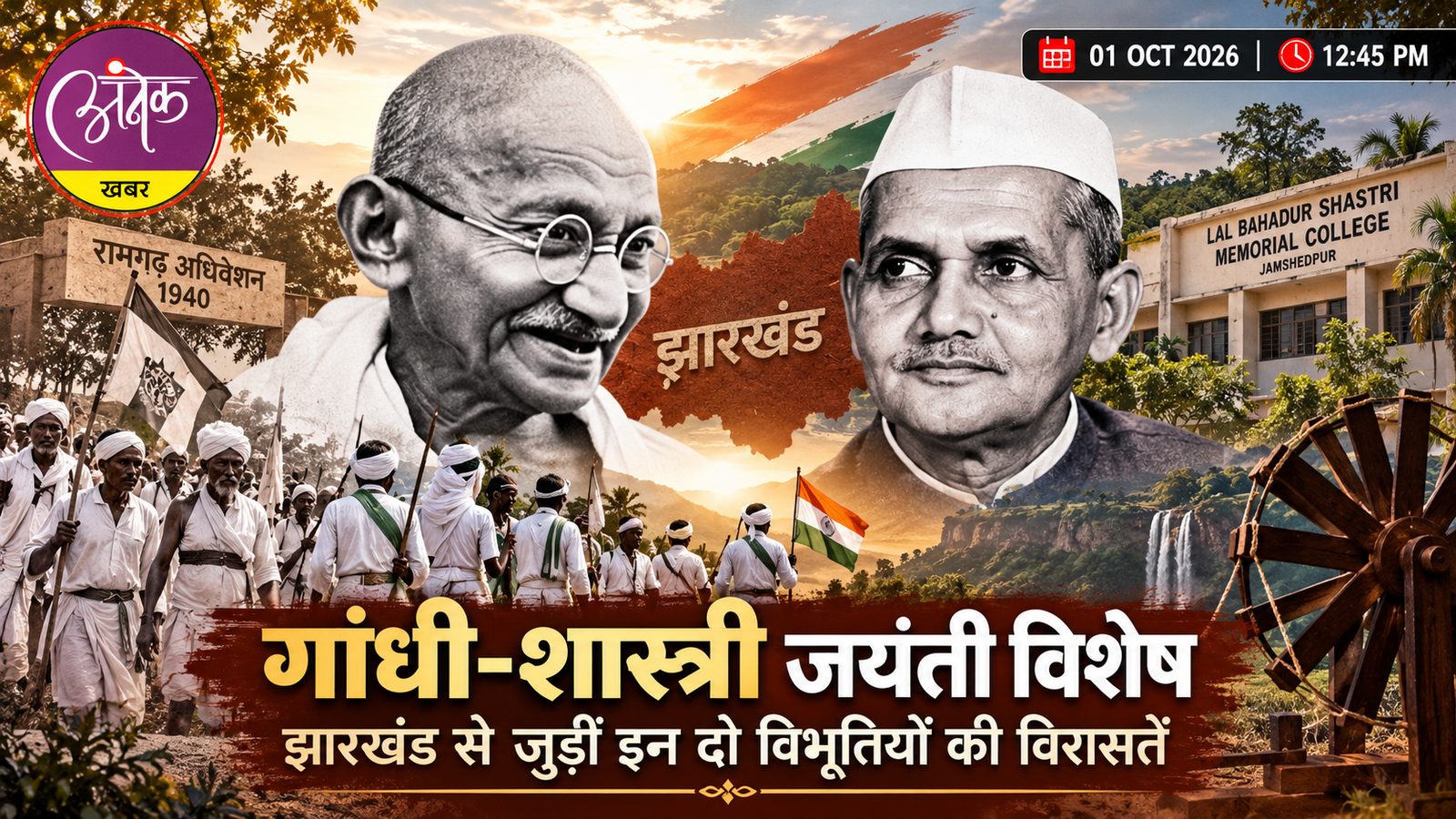
October 2 is a day in Indian history that marks the birth anniversaries of two great figures—Father of the Nation Mahatma Gandhi and former Prime Minister Lal Bahadur Shastri. For Jharkhand, this date is not only an occasion to remember national history, but also a day to recall the stories of the freedom movement, in which Gandhi, the Tana Bhagats and the land of Chotanagpur shared a deep connection.
Mahatma Gandhi’s connection with Jharkhand can be traced back to 1917, when, during developments related to the Champaran movement, he met Sir Edward Gait, the then Lieutenant Governor of Bihar and Orissa, in Ranchi. Gandhi visited Jharkhand again in 1925. On September 17, in Ranchi, he appealed for the promotion of the spinning wheel and khadi. At a gathering of women, he sought contributions for the Deshbandhu Memorial Fund, in response to which several women even donated their jewellery.
Tana Bhagats Were Inspired by Gandhi
One of the most notable stories of Gandhi’s visits to Jharkhand is that of the Tana Bhagat movement. Started in 1914 under the leadership of Jatra Oraon, the movement was initially associated with social and agricultural problems. Later, the Tana Bhagats were influenced by Gandhi’s ideas of non-violence, Swadeshi and non-cooperation. They wore khadi, operated spinning wheels and travelled long distances with the Congress flag to attend gatherings. According to the history details of the Ranchi district administration, a large number of Tana Bhagats participated in the Gaya Congress session in 1922.
Mahatma Gandhi also greatly appreciated the commitment of the Tana Bhagats. In 1925, he saw around 400 Tana Bhagats operating spinning wheels and mentioned their dedication to khadi and the spinning wheel. Later, the Tana Bhagats began respectfully referring to Gandhi as “Gandhi Maharaj” or “Gandhi Baba.” Their presence was also recorded at the Ramgarh Congress session in 1940, where they presented Gandhi with a purse of Rs 400.
Attended the Ramgarh Session
Ramgarh is another important chapter in Gandhi’s journey through Jharkhand. In 1940, the session of the Indian National Congress was held in Ramgarh, with Maulana Abul Kalam Azad as its president, and several leaders including Gandhi, Jawaharlal Nehru and Sardar Patel attended. During this period, Gandhi emphasized issues related to khadi, social reform and the freedom movement. In his speeches in Ramgarh, he described khadi and village industries as an important foundation of the freedom struggle.
October 2 also marks the birth anniversary of Lal Bahadur Shastri. Shastri was born on October 2, 1904, and was deeply influenced by Gandhi’s ideas. The official details of the Prime Minister’s Office mention the Gandhian simplicity and spirit of service reflected in his thoughts. His famous slogan, “Jai Jawan, Jai Kisan,” highlighted the importance of both national security and agriculture.
Lal Bahadur Shastri Memorial College in Jamshedpur
Shastri’s institutional legacy in Jharkhand is associated with Lal Bahadur Shastri Memorial College, located in Karandih, Jamshedpur. The college was established in 1971, and its foundation stone was laid by Shastri Ji’s wife, Lalita Shastri. The institution continues to be associated with Shastri’s name and his ideals of education, discipline and social responsibility.
Thus, October 2 presents two different but connected messages for Jharkhand—Gandhi’s non-violence, Swadeshi and public participation, and Shastri’s simplicity, discipline and respect for farmers and soldiers. And between these, the story of the Tana Bhagats shows that the land of Jharkhand made not only the leaders, but also ordinary people from villages and tribal communities, active participants in the history of the freedom movement.